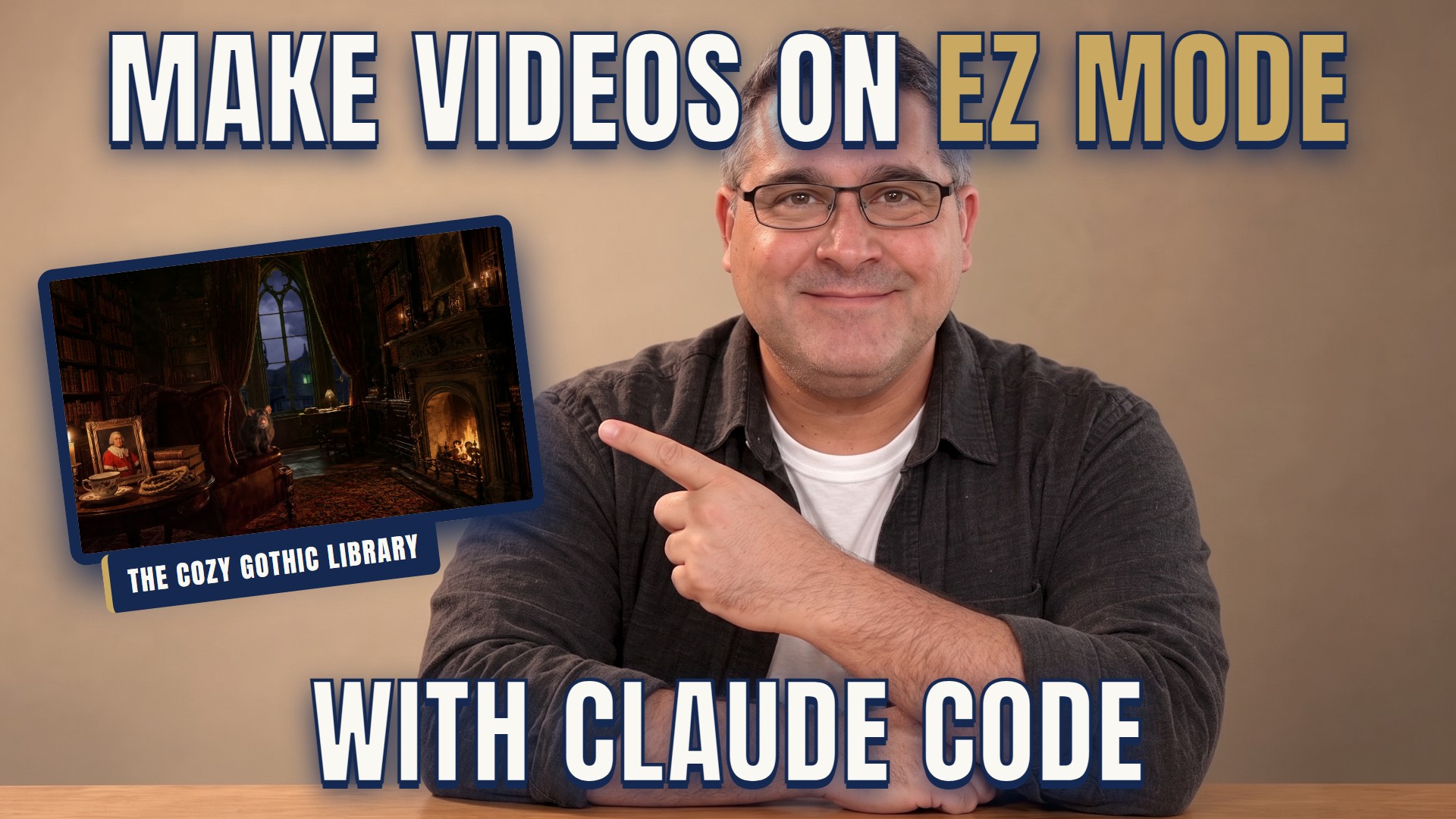
Watch the video on YouTube (5:35).
I have a hobby channel called The Cozy Gothic Library. Classic ghost stories and gothic poems, all public domain, read by an AI narrator. It started because I was bored, I'm an Edgar Allan Poe fan, and I'm fairly comfortable using AI in my business.
It also turned into the cleanest test I know of the work I do for clients. Find where the time is going, then get it back.
Here are the numbers:
- The Raven, 11 minutes. About 8 hours of my time, by hand.
- The Judge's House, 56 minutes. About 1 hour of my time, most of it listening to check for accuracy.
A video five times longer, for one eighth of the time.
Where the 8 hours went
When I made The Raven, the creative part was small. Most of the hours went into moving work from one tool to the next.
- Claude drafted the narration.
- I copied lines out of Claude and pasted them into ElevenLabs, one at a time.
- Adobe Audition for the audio edits, including a multi-track audio bed: a creepy drone, rain, other sound effects, and sometimes very quiet music.
- Adobe Premiere Pro to put the audio and still images together into a video.
- Adobe Media Encoder to encode the final version.
Every step was a hand-off. None of them needed me. They just needed someone. It was a bit of a nightmare.
That's the pattern I look for in every business I work with.
What I did about it
I'm not a programmer. I didn't write a line of code.
I gave Claude Code all my files from the earlier videos and asked if it could build new ones in the same style.
Spoiler alert, it can. It built a Python pipeline that handles the hand-offs for me.
How it works now: 7 steps, 2 human checks
- Text. Claude drafts the narration and a settings file from the public domain text. I read them over.
- Voice. ElevenLabs voices it in small chunks. Then Whisper transcribes the audio and checks it against the script, word for word. A misread line gets re-voiced on its own.
- Art. kie.ai generates two 4K options for each scene. I pick one.
- Check 1. A fast 1080p preview. I watch and listen.
- Render. ffmpeg builds the 4K video. Fire and candle overlays, a slow push-in, room sound, leveled to YouTube's loudness standard.
- Package. Thumbnail, captions, title, description, chapters and tags, ready to paste.
- Check 2. I watch the final and upload it myself.
Nothing goes public until a person has watched it. AI does the moving. A person does the judging. That split is the whole point.
What it costs and what you need
- Claude Code: comes with any paid Claude plan. Pro starts at $20/mo.
- ElevenLabs Creator: about $18/mo, billed annually. That's the narrator voice.
- kie.ai: about $0.09 per 4K scene image. The 56 minute story used 15 scenes.
- ffmpeg, Python and Whisper: open source.
- Your computer: no graphics card needed. 16 GB of RAM covers 1080p. Plan on 32 GB for 4K.
Prices checked September 30, 2026.
This video, too
The video above was made the same way. From approved plan to live on YouTube took about 3.5 hours, same day.
The intro is an AI avatar of me, with an AI clone of my voice. If you know me, it's easy to tell it's not me. For one thing, the avatar has no tattoos.
My hands-on time: about 10 minutes setting up the avatar, under a minute on the voice clone, editing the script, and two watch-throughs. Claude Code did the rest while I worked on other things.
One lesson learned. The avatar never blinks. You don't notice at first. Then you realize it's been talking for a minute straight without blinking. Next time I keep avatar shots short and cut to visuals.
Your business has its own 8 hours
You probably don't make ghost story videos. But you likely have your own version of my 8 hours:
- The report somebody rebuilds by hand every week.
- Numbers copied from one system into another.
- Invoices chased one text at a time.
- Follow-up that only happens when somebody remembers.
The work itself usually isn't the problem. The hand-offs are. That's where the time goes, and the money and efficiency usually go with it.
That's what I do. I'm a Business Operations Consultant. I help businesses find where they're losing time, money, and efficiency. Then I show them how to recover all three, and even exceed previous benchmarks. Sometimes the fix is AI. Sometimes it's a simple automation, or rewriting how a process runs.
If that list sounds like your week, tell me about it.
Cheers!