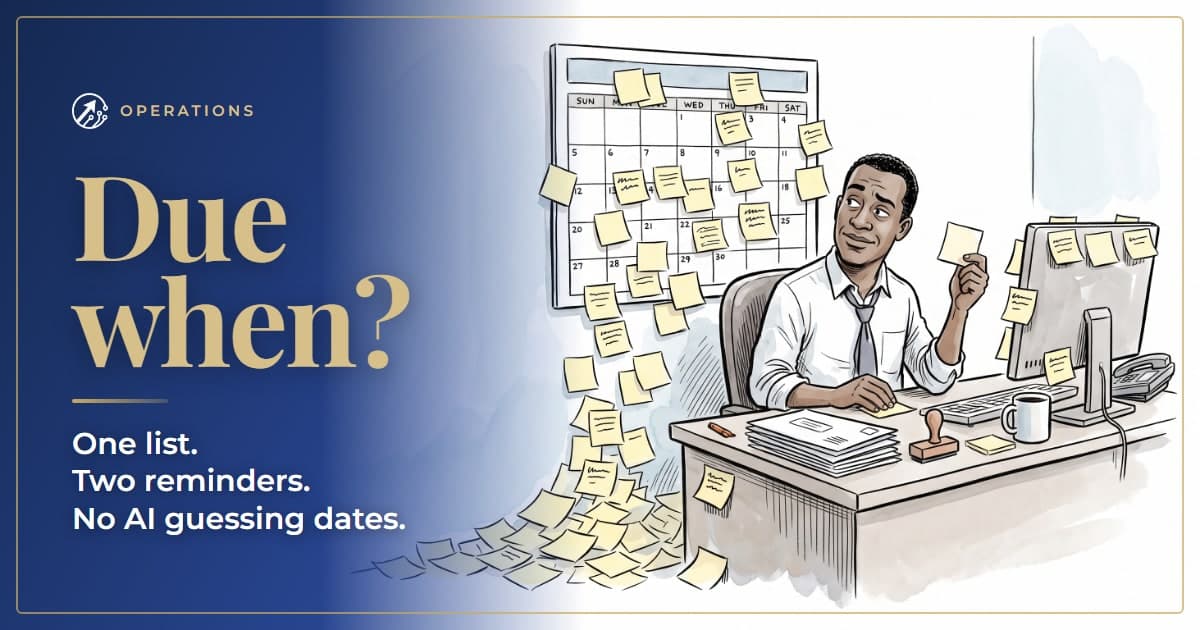
A solo attorney on Reddit put it better than I could:
"the compliance side of things is a second, unpaid full-time job. between tracking deadlines, client funds, and the ever-changing rules, my system of sticky notes and calendar alerts is on the verge of catastrophic failure."
An owner on r/smallbusiness said the same thing with a number on it:
"I feel like I spend like 75% of my time dealing with renewals, taxes, licensing, etc."
And an Etsy seller whose side hustle turned into the main income:
"Just spent 3 hours trying to figure out what forms I actually need for my little side hustle that somehow became my main income this year."
When I went through owner complaints across Reddit, review sites and trade forums, paperwork and deadlines showed up in 12 separate sources. Lawyers, insurance agents, realtors, online sellers, mineral owners. Different paperwork. Same problem.
Nobody's deadlines are written down in one place. They live in sticky notes, inbox searches and somebody's memory. That works right up until it doesn't.
The list nobody writes down
Ask most owners to name every deadline their business has in a year. They'll get about half.
Here's the usual list. Yours will have a few of its own.
- Business registration or annual report with the state
- Professional licenses and continuing education hours
- Insurance renewals (liability, auto, workers' comp)
- Sales tax filings
- Payroll tax deposits and quarterly estimated taxes
- Permits and inspections
- Vehicle registrations
- Equipment or staff certifications
- Domain name and website renewals
- Contracts and leases with an auto-renew date
None of these are hard. They're just scattered. And the penalty for missing one is usually bigger than the work of tracking it.
Build it once
This is a one-afternoon job. A spreadsheet, nothing fancy. One row per deadline, with these columns:
- What it is
- Who issues it (the state, the county, the carrier)
- Due date
- How often (yearly, quarterly, monthly)
- Where the paperwork lives
- Who owns it (you, your bookkeeper, your office manager)
Then put every one of them on a calendar with two reminders. One a month out, one a week out. If somebody else handles it, it goes on their calendar too.
That's it. A list and two reminders. Rules, not judgment. No AI involved.
The point isn't the spreadsheet. The point is that the deadlines stop living in your head.
Where AI actually helps
Two places.
Reading the notice. A letter from the state shows up written in the most confusing English ever printed. Paste the text into ChatGPT or Claude and ask four questions. What is this? What does it want me to do? By when? What happens if I miss it? You'll get a plain-English answer in seconds.
Building the first draft of your list. Tell it your business type, your state and how many employees you have, and ask what licenses, filings and renewals usually apply. It's a good starting checklist. Then confirm each one with the agency, your CPA or your insurance agent.
One rule for both: strip the numbers before you paste. Tax IDs, Social Security numbers, account numbers and client files stay out of a chatbot.
Where AI stays out
The deadlines themselves.
AI can be confidently wrong about a date. It can mix up states, read an old rule or just guess. For a social post, that's a typo. For a court deadline, a trust account rule or a tax due date, that's a real problem.
So the date always comes from the source. The notice, the agency's website, your CPA. You put it on the calendar yourself. AI can explain what the deadline is. It doesn't get to decide when it is.
That attorney's sticky notes are a problem. A chatbot guessing the date would be a worse one.
Start this week
Pick the three deadlines that would hurt the most to miss. Put them in a spreadsheet, put them on the calendar with two reminders each, and add the rest as they come up. The list builds itself from there.
Want help with the confusing ones?
That's what Outside the Chat Box is for, my Skool group for small business owners using AI (and knowing where it doesn't belong). There's a lesson in there on comparing an insurance renewal to last year's, and owners swapping the notices that confused them.